Artificial Intelligence (AI) is becoming a common part of our daily life. Today, people use AI tools for writing, studying, coding, creating images, making videos, research, business work and many other tasks. But have you ever wondered why the same AI tool can give a very different answer to two different people?
The main reason is often the prompt.
A prompt is simply the instruction or question that we give to an AI tool. For example, if you ask an AI, Write an article about smartphones,” it may give you a general article. But if you write, “Write a 1,000-word article about the latest smartphone technology in simple English for beginners,” the result can be much more useful.
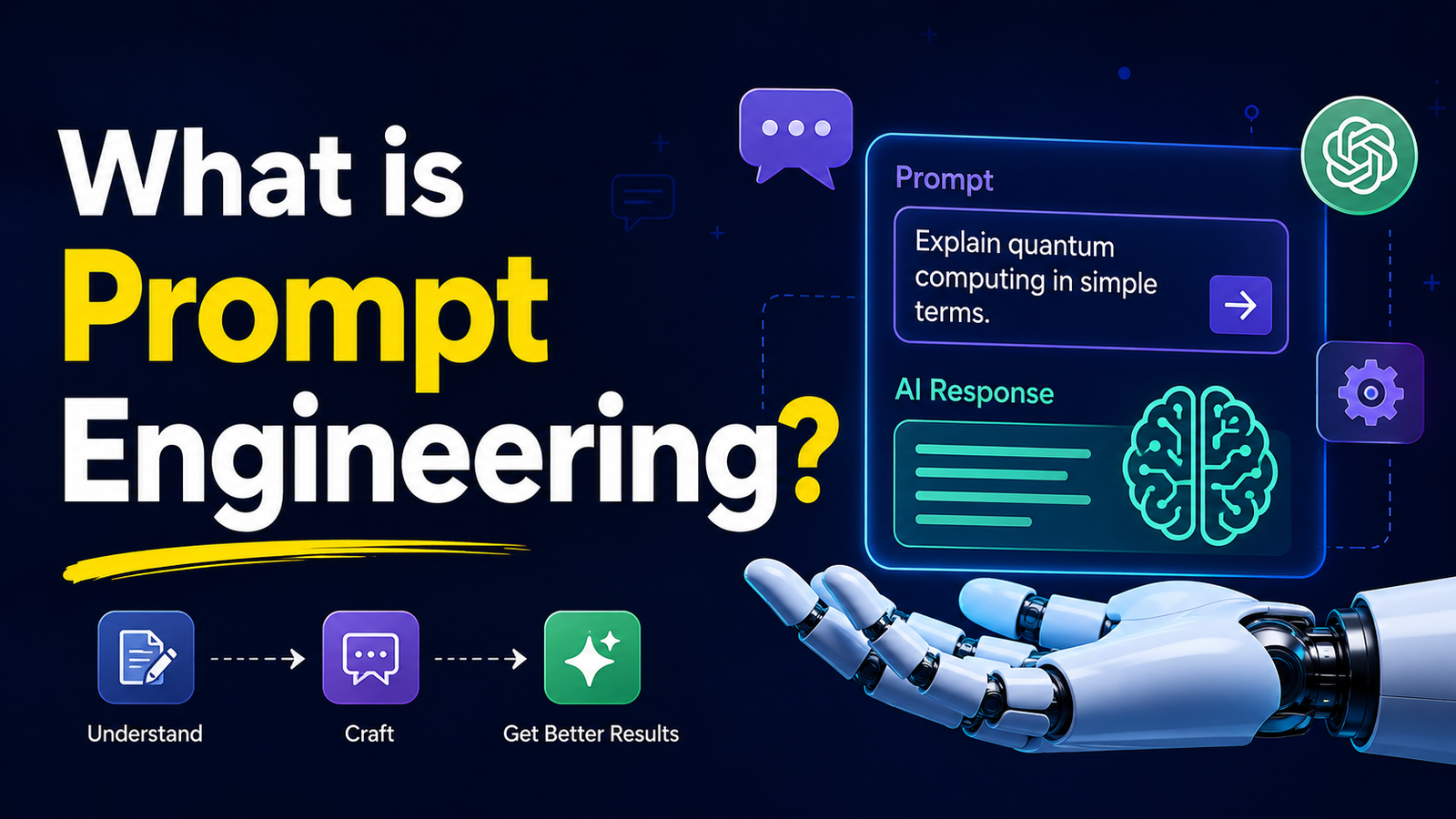
The process of creating clear and effective instructions for AI is called Prompt Engineering.
In simple words, prompt engineering means learning how to communicate with AI in the right way. It is not only about asking questions. It is about giving enough information, context, goals, examples and instructions so that the AI can understand what you actually want.
Prompt engineering is becoming an important skill because AI tools are becoming more powerful. A well-written prompt can save time, improve the quality of the result and reduce the need for repeated corrections.
You do not need to be a programmer to learn prompt engineering. Anyone who regularly uses AI can learn the basics and become better at it.
How to Write a Perfect Prompt
Writing a good prompt is easier when you understand what information the AI needs. There is no single prompt that can be called perfect for every situation, but a clear and detailed prompt usually gives better results.
First, clearly explain what you want. Avoid very short or confusing instructions. For example, instead of saying “Write about YouTube,” you can say, “Write a beginner-friendly article explaining how YouTube recommendations work.”
Second, provide context. Context helps AI understand the situation. If you want an email, tell the AI who the email is for and what the purpose is. If you want an article, mention the target audience and writing style.
Third, mention the format you want. You can ask for bullet points, a table, an article, a social media caption, a script or a step-by-step guide.
You can also mention the tone. For example, you may want the content to sound professional, friendly, natural, simple or conversational.
Another useful technique is giving an example. If you show AI the type of output you expect, it becomes easier for the AI to understand your requirement.
A useful prompt can therefore include five basic things: role, task, context, requirements and output format.
For example:
“Act as a professional content writer. Write a 1,000-word article about smartphone security for Indian beginners. Use simple English, short paragraphs and a natural conversational tone. Add suitable headings and end with a conclusion.”
This prompt is much more specific than simply saying, “Write an article about smartphone security.”
- Prompt Engineering Demands
Prompt engineering may look simple, but creating consistently useful prompts requires some important skills.
The first demand is clear communication. You need to explain your requirement in a way that is easy for the AI to understand. If your instructions are unclear, the output may also be unclear.
The second demand is logical thinking. You should know what information the AI needs to complete the task. This is especially important for complicated work such as coding, research, business planning or data analysis.
Another important requirement is patience. Your first prompt may not always give the result you expect. Good prompt engineering often involves testing the prompt, checking the result and improving the instructions.
Understanding the limitations of AI is also important. AI can sometimes misunderstand instructions, provide incorrect information or miss important details. A prompt engineer should therefore review the output instead of blindly trusting everything generated by AI.
Creativity is another useful skill. Sometimes, a creative approach to writing the prompt can produce much better results. This is especially useful when creating images, videos, advertisements, stories and marketing content.
So, prompt engineering demands communication skills, logical thinking, creativity, patience and the ability to analyse AI-generated results.
Why Prompt Engineering is Important?
Prompt engineering is important because AI is only as useful as the instructions it receives. A powerful AI model can still produce an unhelpful answer if the user’s request is too vague.
For students, good prompts can help with learning difficult topics, creating study plans and understanding complex subjects in simple language.
For content creators, prompts can help generate video ideas, scripts, captions, titles and creative concepts. Instead of spending hours starting from a blank page, creators can use AI as a starting point and then add their own ideas.
Businesses can also benefit from prompt engineering. AI can assist with customer support, emails, reports, marketing content and internal documentation.
Developers can use detailed prompts to explain programming requirements, find possible errors and generate or improve code.
The biggest advantage is saving time. When the prompt is clear, there is usually less need to repeatedly explain the same requirement or correct the output.
Common Mistakes in Prompt Engineering
Many beginners make simple mistakes while writing prompts. One of the most common mistakes is being too vague.
For example, “Make a good image” does not tell the AI what kind of image you want. A better instruction would describe the subject, style, background, lighting, camera angle, aspect ratio and other important details.
Another mistake is giving too many unrelated instructions at once. If a prompt contains conflicting requirements, the AI may struggle to decide which instruction is more important.
Using unclear language can also create problems. If a specific result is required, the instructions should be as precise as possible.
People also sometimes forget to mention their target audience. Content written for children, beginners, professionals and experts can be very different.
Finally, many users do not review their AI output. Even a well-written prompt cannot guarantee that every answer will be correct. Important information should always be checked before using it.
Conclusion:
Prompt engineering is the skill of giving clear, useful and well-structured instructions to an AI system. It helps users get better results from AI tools without needing advanced programming knowledge.
A good prompt should clearly explain the task, provide relevant context, mention important requirements and describe the expected output. Learning this skill requires practice, clear communication, logical thinking and creativity.
As AI continues to become a bigger part of education, business, content creation and everyday work, knowing how to communicate effectively with AI can become a valuable skill.
The good thing is that anyone can start learning prompt engineering. You do not need to become an expert in one day. Start with simple prompts, check the results, understand what went wrong and improve your instructions.
In the future, knowing what to ask AI and how to ask it may become just as important as knowing how to use AI itself.